Resources
Much of what has shaped how I understand psychotherapy has come through experience — through relationships, the body, dreams, places, the living world, spiritual practice, communities, loss, encounters with mortality and change.
Books and other people's work have travelled alongside these experiences, sometimes arriving at moments when an established way of understanding myself or the world was beginning to shift.
What follows is not a reading list or a programme to work through. It is a small collection of books, films, writings and other encounters that have mattered to me. I offer them here simply as possibilities. Follow what draws you.
Body, psyche and relationship
Virginia Satir — Your Many Faces
A small and very human book about the different parts or faces through which we meet ourselves and others. Satir's warmth, playfulness and trust in people's capacity for change have stayed with me.
Stanley Keleman — Your Body Speaks Its Mind
Keleman's work was important in my growing understanding that our bodies are not simply containers for psychological experience. How we organise ourselves bodily is intimately involved in how we feel, relate and live.
James Hillman — The Thought of the Heart and the Soul of the World
An invitation beyond a psychology concerned only with an interior, individual self — towards imagination, beauty, soul and a world that is itself alive with meaning.
Earth and the living world
Robin Wall Kimmerer — Braiding Sweetgrass
A book I return to for its invitation into reciprocity: how our relationship with the living world changes when we ask not only what we can receive, but what we might give.
Mary-Jayne Rust — Towards an Ecopsychotherapy
An important companion in bringing psychotherapy into conversation with ecological life and recognising that our psychological lives cannot finally be separated from the Earth of which we are part.
Mary-Jayne Rust & Nick Totton — Vital Signs
A collection exploring psychotherapy's relationship with ecopolitics, embodiment and the more-than-human world. It helped open territory in which my own psychotherapy and ecological work could meet.
Richard Powers — The Overstory
A novel in which trees cease to be scenery and become participants in the story. Perhaps fiction sometimes brings us into relationship with the living world in ways argument cannot.
Living in these times
Vanessa Machado de Oliveira — Hospicing Modernity and Outgrowing Modernity
Two challenging invitations to notice the assumptions of modernity that live through us — and to remain present as ways of knowing and being that we have taken for granted become increasingly inadequate for the world we are entering.
Nora Bateson — Combining
Writing that continually draws attention away from isolated things and towards relationship, context and the patterns between. A book less concerned with providing answers than with changing the conditions from which questions arise.
Amitav Ghosh — The Nutmeg's Curse
A powerful exploration of colonialism, extraction and ecological crisis, and of the stories through which the Earth came to be treated as inert matter available for human use.
Adam Curtis — The Century of the Self
A documentary series about the emergence of consumer culture and the psychological ideas that helped shape it. Useful, unsettling viewing for anyone curious about how thoroughly our sense of being an individual self is entangled with the culture around us.
Other openings
Antoine de Saint-Exupéry — The Little Prince
A book ostensibly for children that keeps asking adult questions about love, loss, relationship, responsibility and what we have forgotten how to see.
Margery Williams — The Velveteen Rabbit
A small story about becoming real — not through perfection, but through relationship, love and the marks that living leaves upon us.
David Whyte — The House of Belonging
Poetry concerned with belonging, vulnerability, landscape, relationship and the conversation between an inner life and the wider world.
John O'Donohue
His poetry and prose return repeatedly to thresholds, belonging, landscape, friendship and mystery. I particularly value the way his work allows psychological and spiritual experience to remain connected with place.
And sometimes, put the book down
Not everything that has taught me can be put on a bookshelf.
Some of the most important learning in my life has happened through sitting, walking, swimming, diving, touching and being touched, working with land, paying attention to dreams, being in relationship — and staying somewhere long enough for my habitual way of seeing to quieten.
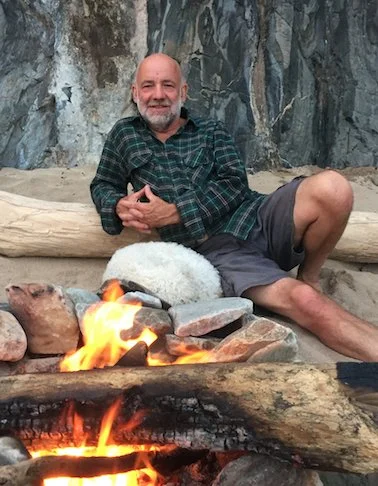
The ocean has been one of those teachers. I have known it through fishing and diving, snorkelling and coasteering, walking beaches and gathering stones and bones. And since my teens there have been particular wild places where I have encountered something both humbling and relieving: a sense of my own smallness within a world immeasurably larger than me.
Glendalough, near Glencolumbkille in Donegal, was one of the first. Doon Head in Knoydart, many years later, confirmed something I think I already knew.
So I could as readily offer a place as a book.
Find somewhere that calls to you. A shoreline, woodland, hillside, riverbank — or somewhere else entirely. Stay longer than seems necessary. There is nothing particular to achieve.
See what happens.
A story that won’t kill
What did my father teach me
(without meaning to) those days
when he sat on the boulder
in the sunshine, reading his paper.
Black ants emerging from underground
to crawl over his body.
He didn’t flinch or brush them away.
Just carried on catching up with
the news.
Robbie Breadon, 8 May 2011